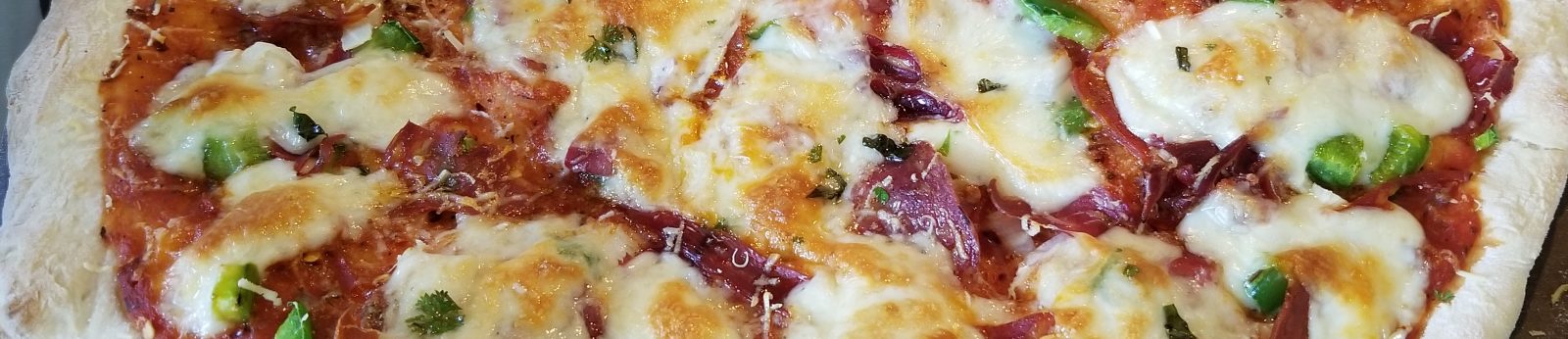
The is a multi-day pizza dough with italian origins that is jam packed full of flavour from additional fermentation time. It also uses less yeast than my regular dough mix so it is certified pandemic proof.
The Biga dough can be considered as an italian riff on a sour dough. Basically you make a small starter dough and leave it to ‘funk up’ for two days before finishing it into a pizza dough.
For the Biga starter, mix in a small bowl:
- 65 g ’00’ flour
- 40 mL room temperature water
- 1/8 teaspoon of yeast
Once you have a small dough ball, wrap your bowl with some plastic wrap and let it sit (in room temperature) for 12-18 hours (the longer, the more sour).
After your time has elapsed, you will now need to work on the rest of the dough volume (the non-sour mixture).
First start by dissolving 4 g of yeast into 185 mL of room temp water.
Then combine in your stand mixer:
- 275g ’00’ flour
- 6 g table salt
- water/yeast slurry
The dough will look dry at this point (see below pic).
If you look at your Biga at this point, it should have risen to about double its original size by now. ( I didn’t take enough pics for this post and I apologize!!)
At this point in mixing, begin adding your Biga into the stand mixer in small chunks until almost completely smooth. Finish mixing with 20 mL of olive oil into the dough and that will smooth out the dough ball.
Now take your dough baby and pop it into a container with a lid and let it rest for one hour. After the hour, fold the dough over itself ONCE (don’t ask me why I don’t know), and let it rest again for another hour. After that, the dough baby goes into the frige to chill out for 24-48 hours. Remember folks, the longer the wait, the more sour the dough becomes. If you are going to leave it in the fridge for longer than two days, you get into a whole other ballgame with feeding the yeast and trust me you don’t want to go there.
When you are ready to use your dough, allow it to come up to room temperature before trying to manipulate it (maybe like 2 hours out on the counter warming up). For shaping and pizza dough twirling, the same rules apply as my previous lessons (see Doughs.)
This dough is optimally cooked at extremely high temperature. I cooked mine at 515F but honestly the oven could have been higher. Additionally, this recipe will make two 10-11 inch pizza rounds, with each dough ball weighing ~280g each.
 Our Daily Pizza